The Best Dog Training Apps for Busy Families in 2026: 5 Picks That Fit Real Life

A new puppy lands in a house that already runs on carpools, nap schedules and weekend road trips. Nobody has a free hour for dog training every evening. Most families have ten minutes after breakfast and a walk where the leash becomes a tug of war.
That gap is where dog training apps earn a spot on your phone. The good ones break training into short lessons, remind you when to practice, and keep everyone in the house on the same plan. The weaker ones sell a subscription you forget to cancel.
This guide compares five of the best dog training apps for families: who each app suits, what you get for free, what paid plans cost at the time of writing, and when an app is not the right tool.
Quick Answer: The Best Dog Training Apps for Families
Woofz is the best all-in-one pick for family routines: a personalized training plan plus care tools, reminders, multiple dogs and family sharing in one app.
Zigzag is a puppy training app built for structured puppy development, with daily lessons set by your puppy's age and breed.
Dogo is the best choice for trick training with kids, thanks to its built-in clicker, whistle and 100+ tricks.
PawChamp fits families who want to message real trainers without booking a session.
Pupford is the best free starting point, with a full video course that costs nothing.
How We Chose These Apps
To find the best dog training apps for a busy household, we held each one to five checks.
Training approach. Positive reinforcement only, with no punishment or dominance tactics.
Trainer credentials. Clear information about the certified trainers or experts behind the lessons.
Family fit. Short lessons, reminders, and training plans more than one person can follow.
Pricing transparency. A visible free option or trial, and prices you can check before paying.
Honest scope. No promise that an app replaces a qualified professional.
Every claim comes from store listings, developer materials or published research (see Sources). Dog training apps change often, so treat this as a snapshot.
1. Woofz: Best All-in-One App for Family Routines
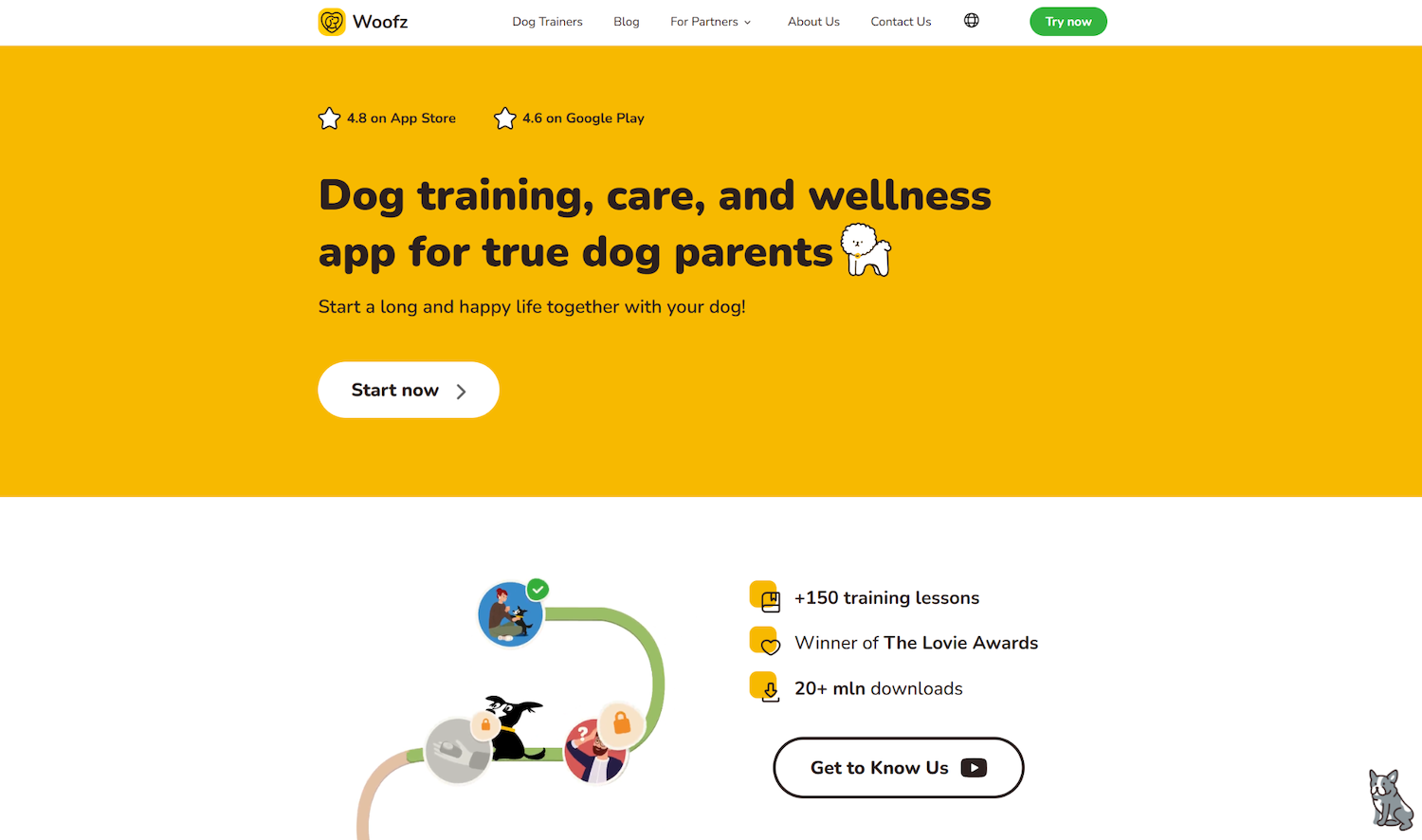
Woofz is a dog training and care app built around your actual dog rather than a generic curriculum. Setup is user-friendly: you answer a few onboarding questions, add a dog profile with name, breed, age and photo, and the app builds a personalized path called My Plan. It works for a new puppy, a teenage dog testing every rule, or an adult rescue who needs a fresh start.
What makes Woofz a strong family pick is the mix. Training, everyday care and guidance live in one app, so the person walking the dog, the person feeding the dog and the kid practicing "sit" in the kitchen all see the same plan. The personalization adjusts as your dog grows and your goals change.
Key features
My Plan. A step-by-step path with lessons, commands, quizzes, small commitments and practice steps, built to form habits rather than just hand you valuable information.
Explore. A library of troubleshooting programs for everyday problems such as chewing and biting, basic and fun commands, a Commands Bootcamp, and games for enrichment.
Care tools. Routine setup, daily goals, walk and activity logs, food and water logging, relaxation sounds and calendar-style progress tracking.
Family setup. Multiple dog profiles, family sharing, daily reminders and a built-in clicker.
Every lesson uses positive reinforcement, and Woofz lists its trainer team on its site, including CPDT-KA certified dog trainers. Training sessions are planned at about 10 to 15 minutes a day.
The core idea is refreshingly human. A few minutes on the couch, one cue practiced during a walk, or one small habit repeated daily still counts.
Free version vs. paid plan
Woofz is a free download with a genuine free tier. At $0 you get the first level of My Plan, a small set of basic commands, some early quizzes, a few programs, support for multiple dogs, daily reminders, and routines with daily logging.
A subscription opens the rest of My Plan, most commands, quizzes and programs, the full Explore library, and insights on top of your daily logs.
Most new users see a 3-day trial that then renews automatically as a weekly plan until canceled. Some see a 7-day trial or a 7-day offer for $1 instead, and longer plans may appear depending on region and platform. Prices load from the App Store or Google Play and vary by country, so check the price in the app before your trial ends.
Who it suits
Families who want training and daily care in one place, households with multiple dogs, and new dog owners who like knowing exactly what to practice next. It is also a good app for dog parents who want to hand small, clear tasks to older kids.
Keep in mind that most of the command and program library sits behind the paywall. And like all dog training apps, Woofz is a practice companion. It does not replace a veterinarian or a certified behavior professional for serious issues.
2. Zigzag: Best Puppy Training App for Structured Puppy Development
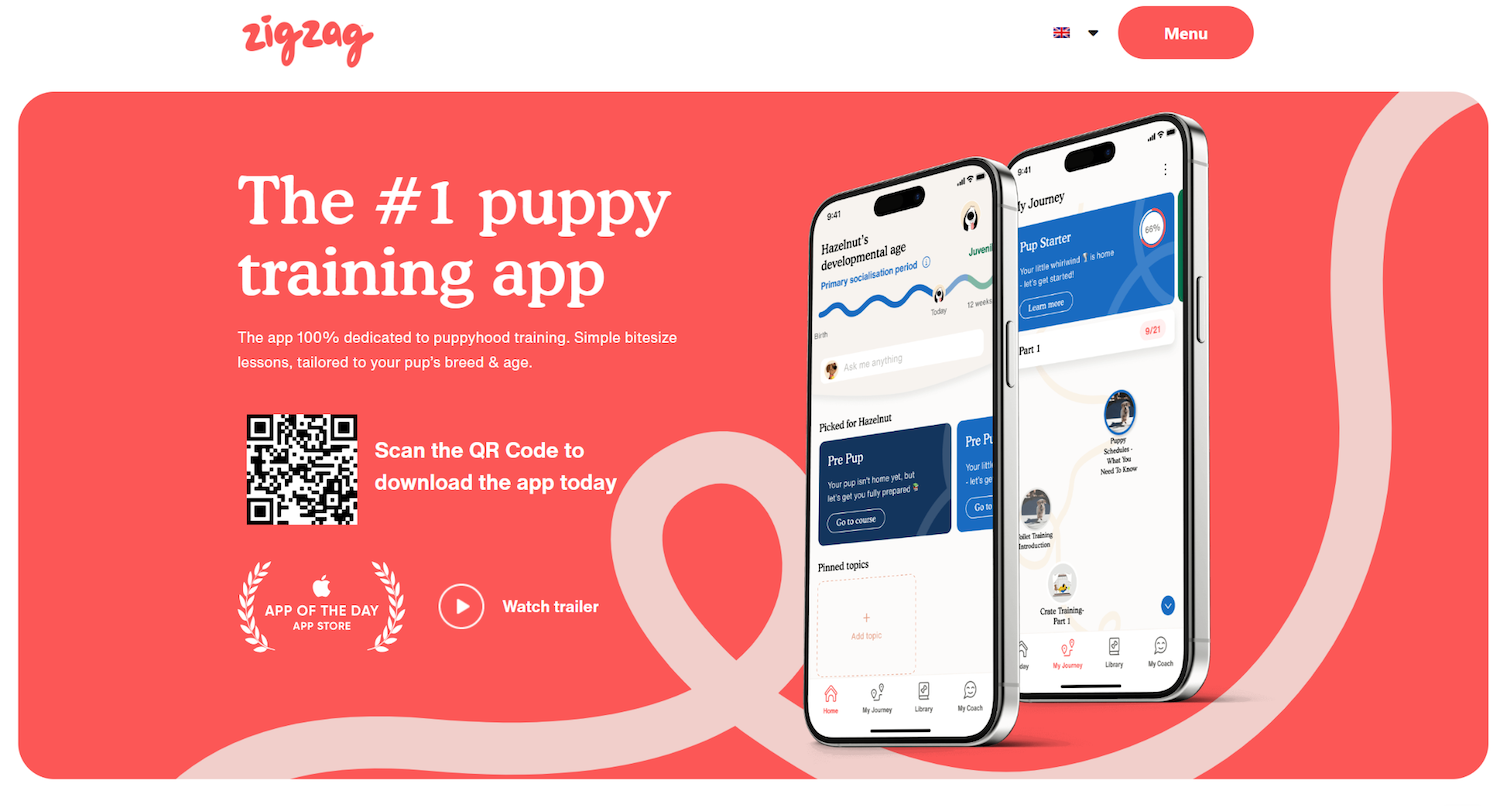
Where most dog training apps cover every age, Zigzag focuses on puppyhood. You enter your puppy's age and breed, and the app builds personalized programs with three short daily lessons. The US App Store listing describes 250+ lessons with how-to videos on basic commands, crate training, leash skills, socialization, biting and potty training (the UK-based team often says toilet training).
Zigzag is open about trainer credentials: its content was first created by accredited trainers and behaviorists, then refined with an advisory board of accredited professionals, according to a 2025 peer-reviewed paper in the journal Animals. That University of Lincoln study surveyed 367 owners and found that completing more of the app's modules was associated with lower odds of more severe problem behaviors, including house soiling.
Two caveats matter. Zigzag funded the study, and the data came from owner reports, so it shows an association rather than proof.
Key features
Three daily lessons paced to your puppy's stage of puppy development.
24/7 chat support with puppy coaches for subscribers.
A community of pet parents for questions and progress updates.
Clear toilet training and socialization modules for the first months.
Pricing and who it suits
The US App Store lists monthly plans at $9.99 to $12.99 and annual plans at $44.99 to $69.99, with a free trial and some free learning content.
It is a great app for puppy owners who want a calm, linear routine through puppyhood, though it becomes less useful once your dog is past adolescence.
3. Dogo: Best for Trick Training With Kids
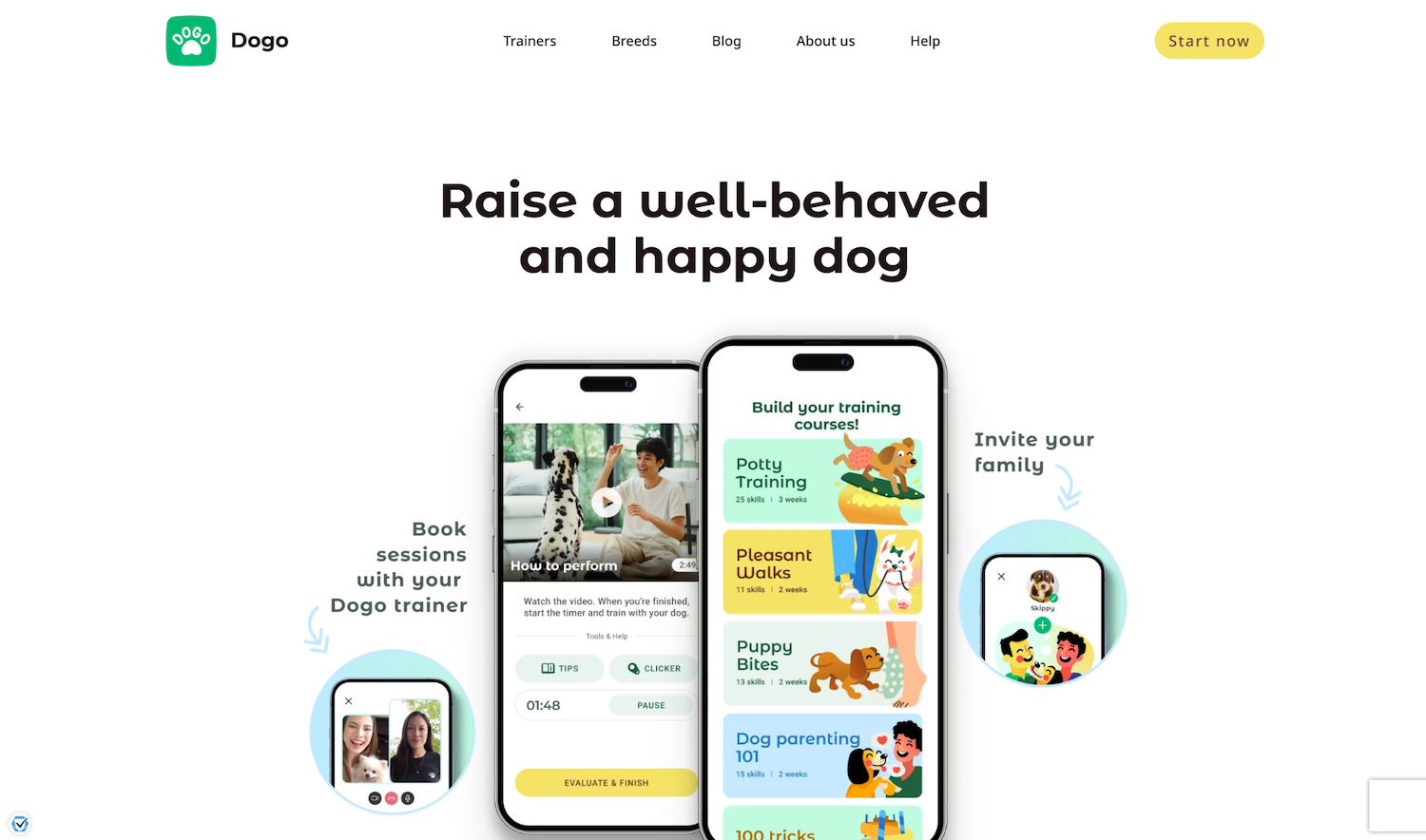
Kids love tricks, and the Dogo app turns them into a family game. The library includes 100+ tricks and exercises with detailed videos, from sit and stay to spin and high-five, plus 12 programs such as leash walking, perfect recall and trick training.
The app's standout is a built-in clicker and whistle. A clicker marks the exact moment your dog does the right thing, which makes reward-based training clearer for the dog and more fun for a nine-year-old helper. You can also send a short video "exam" to Dogo trainers for feedback.
Key features
100+ guided tricks and commands with step-by-step video.
Built-in clicker and whistle.
Video exams reviewed by Dogo trainers.
Potty reminders and progress tracking.
Shared training for up to five family members on one subscription, with logs synced across devices.
Pricing and who it suits
Dogo offers a 7-day free trial, then 1-month or 12-month subscriptions. The US App Store lists subscription price points from $3.99 to $99.99 and a Premium Lifetime option at $299.99 for lifetime access.
It is a good app for families with school-age kids and a food-motivated dog.
The app has no real free tier after the trial. One App Store reviewer noted that a single "yes" on a skill check moves you forward, so keep practicing a cue until it is reliable.
4. PawChamp: Best for Quick Answers From Real Trainers
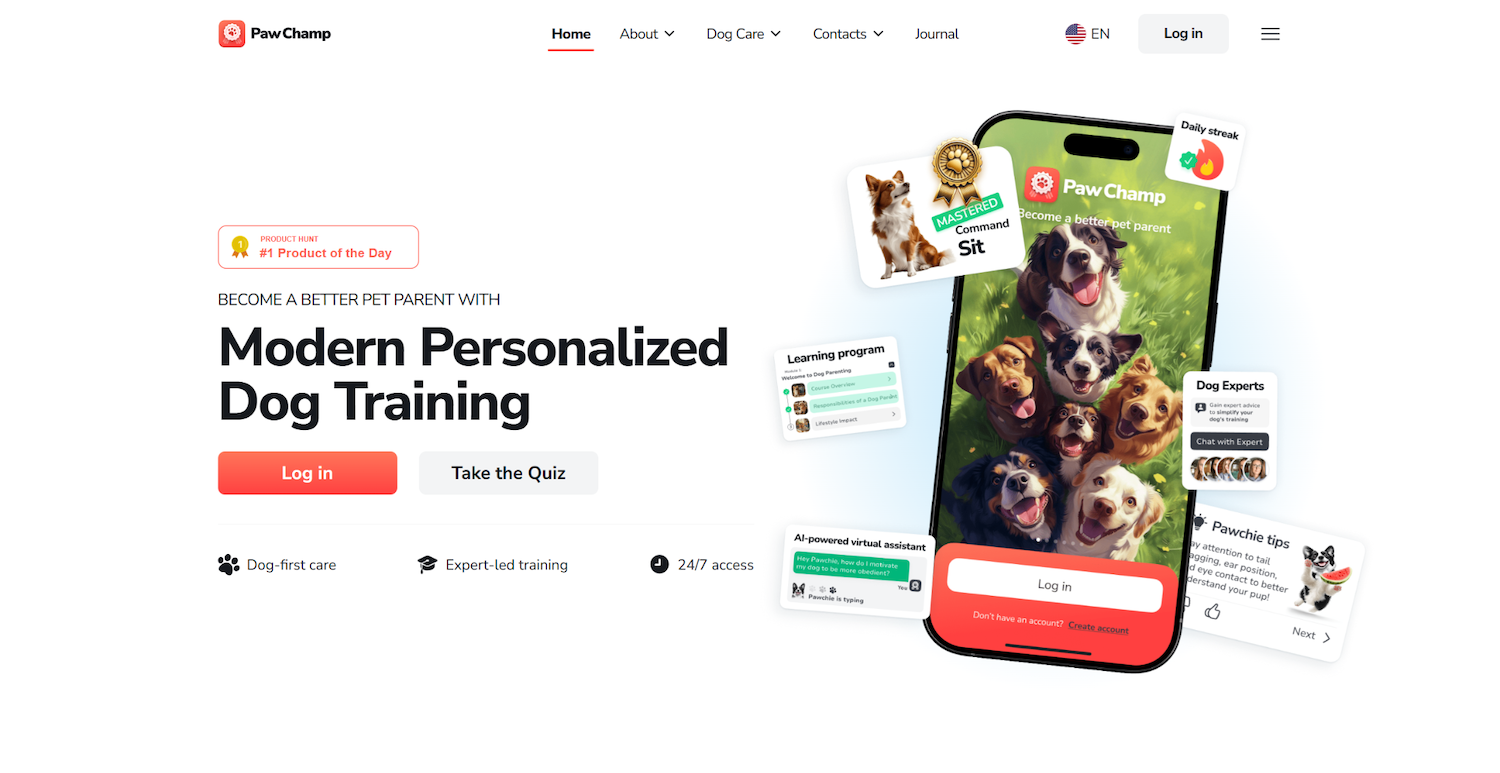
Sometimes you do not need a new lesson. You need someone to explain why your puppy bites the baby gate every evening at six, and that is where PawChamp differs from most training apps. Its store listing says the app was developed with certified dog trainers, behaviorists and canine experts, and it includes in-app chat with professional trainers 24/7 at no extra charge.
You also get personalized dog training plans, video lessons, quizzes, daily streaks and an AI helper called Pawchie, plus lessons on leash pulling, barking and separation anxiety. A walk tracker arrived in recent updates, and a Family plan launched in August 2026 so a household can share one subscription.
Pricing and who it suits
PawChamp is a free download with some free features. The US App Store lists weekly plans at $6.99 to $9.99 and yearly plans at $54.99 to $79.99, plus optional add-on programs.
It suits parents who want professional oversight in their pocket for everyday questions.
Weekly billing adds up, so compare weekly and yearly totals. Chat answers are general guidance, and PawChamp itself advises seeing your vet for health issues.
5. Pupford: Best Free Starting Point
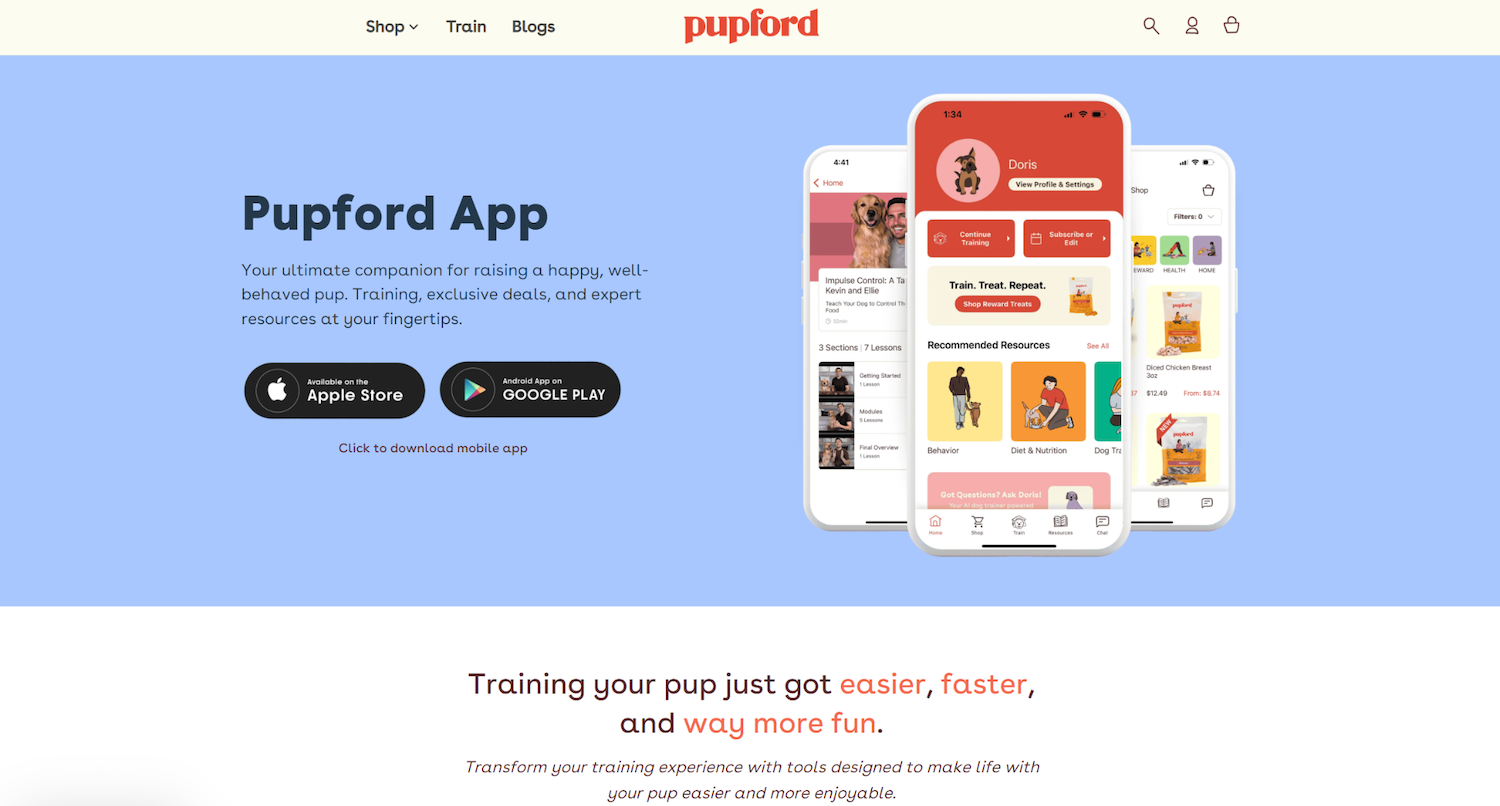
If your budget is tight, start here. Many dog training apps start with a trial that turns into a subscription, but Pupford offers a free 30-day video course with well-known trainer Zak George, called 30 Day Perfect Pup. It needs no credit card at sign up, suits puppies and older dogs, and runs in the Pupford app or any browser.
Lessons follow positive reinforcement, and daily videos cover basic obedience, house training, crate training, leash walking and socialization. The app also has desensitization sounds (thunderstorms, fireworks, doorbells) to play at low volume while rewarding calm, which is handy before the Fourth of July.
Pricing and who it suits
The course is free. On the US App Store, the paid Pupford Academy costs $9.99 per month, $39.99 every six months or $199.99 for lifetime access, and single courses cost $19.99 each.
The app suits budget-minded families testing their commitment. Pupford also sells treats and gear, so expect product suggestions. The free course follows a fixed order, which is fine for basic training but less helpful for a specific problem.
How to Pick the Right App for Your Family
Even the best dog training apps only help if your household opens them. Match the app to your real week.
If you just brought home a new puppy
Puppy owners need clear daily structure for the first week and beyond. Among puppy training apps, Zigzag and Woofz both build a plan around your puppy's age, which matters because puppy development moves fast. Pair any app with this guide to the first 48 hours with a new puppy.
If the kids want to help
Pick short lessons with a clear win. Dogo's tricks suit school-age kids, and Woofz's family sharing makes it easy to split tasks between pet parents and older children. An adult should stay close whenever young children work with a dog, and this guide on adopting a dog when you have small children covers the safety basics.
If you travel with your dog
Road trips are practice in disguise. A hotel room, a trailhead or a patio lunch is a chance to rehearse basic cues somewhere new. Apps with routines and walk logs, like Woofz and PawChamp, keep feeding and potty times steady when everything else changes.
If budget comes first
Free training apps and courses make a low-risk start. Begin with Pupford's free course, then try the Woofz free tier for ongoing structure. Upgrade once you know which extra features you will actually use.
Making Training Stick in a Busy Household
Consistency beats duration. Short sessions, like three two-minute training sessions spread through the day, often go better than one long, frustrated one, especially for puppy training.
Agree on cue words. Put your basic cues on the fridge so everyone says "down" for lying down and "off" for the couch.
Attach practice to routines. Try "sit" before breakfast and "wait" at the front door. Daily habit building works because it rides on things you already do.
Forgive the gaps. Missed a day? Pick it back up tomorrow. Realistic expectations keep families going longer than streaks do.
Track progress lightly. Progress tracking shows small wins, like the first dinner your dog spends settled on a mat.
One money tip applies to all dog training apps. Before any free trial, set a phone reminder for the day before it ends and note whether the plan renews weekly, monthly or yearly.
Clear trial and renewal terms are part of pricing transparency, and a reminder keeps the choice in your hands.
Why Positive Reinforcement Matters
Every one of these dog training apps uses positive reinforcement, rewarding the behavior you want with food, play or praise. The American Veterinary Society of Animal Behavior (AVSAB) says in its humane dog training position statement that evidence supports reward-based methods for all dog training, and it advises against aversive tools such as shock and prong collars.
Reward-based training also teaches you to read your dog's body language, because you watch for moments to reward rather than mistakes to punish. That makes your furry friend easier to understand in daily life and builds trust instead of fear.
Be wary of any trainer whose training methodology leans on dominance or being the "pack leader." Positive reinforcement methods cover basic obedience and everyday manners, and they are the recommended training approach for behavior problems too.
When a Dog Training App Is Not Enough
Dog training apps are excellent for foundations: basic cues, house manners, routines and confidence. On their own, they are not the right tool for severe aggression, resource guarding with growling or biting, compulsive behaviors, or serious separation anxiety.
Work with a qualified professional and loop in your veterinarian, since pain or illness can drive behavior changes. Sudden house soiling in a house-trained dog calls for a vet visit first.
Dog training is largely unregulated in the US, so almost anyone can call themselves a dog trainer. Trainer credentials deserve a quick check before you book.
CPDT-KA. Certified trainers with this CCPDT credential have logged at least 300 hours of dog training in the past three years and passed an exam. CCPDT keeps a public directory.
Veterinary behaviorist. A board-certified veterinary behaviorist (DACVB) is a veterinarian with specialty training in behavior medicine, the right call for complex cases or anything involving medication.
Clear methods. Qualified trainers explain their training approach and avoid promising specific outcomes.
Trainer credentials matter inside apps too. Look for the pro trainers behind the lessons and the chat, and treat an in-person trainer as a partner to your app, not a rival.
Frequently Asked Questions
What is the best free dog training app?
Among free dog training apps and courses, Pupford's 30 Day Perfect Pup is hard to beat, with no credit card needed. If you want an app with an ongoing free tier instead, the Woofz free version gives you the first level of a personalized plan, basic commands, routines, reminders and support for multiple dogs at $0.
What is the 7-7-7 rule for dogs?
The 7-7-7 rule, often called the Rule of Sevens, is a puppy socialization checklist. It suggests that by about seven weeks old a puppy should have positive experiences with seven different surfaces, toys, locations, people, food containers and small challenges. Breeders usually start it, and families continue at home at the puppy's pace. Puppy training apps such as Zigzag build socialization into early lessons.
What is the 3-3-3 rule for dog training?
The 3-3-3 rule describes how a newly adopted dog tends to settle in: roughly 3 days to decompress, 3 weeks to learn your routine, and 3 months to feel at home. It is a guideline, not a deadline, and a reminder to keep training light in the first week.
Is the GoodPup app free?
Not long term. GoodPup, a live video training service now part of Rover, lets new users try it free for the first week, then moves to a paid weekly subscription with one-on-one sessions with certified trainers. Check the current weekly rate before the free week ends, and note that a separate app with a similar name exists in the App Store.
Do dog training apps actually work?
Even the best dog training apps work mainly as a consistency tool for dog owners and pet owners who practice a little every day. Early research is encouraging: a 2025 University of Lincoln study linked higher completion of one puppy app's modules to lower odds of more severe problem behaviors, though the data was owner-reported and industry-funded.
The One Thing to Do This Week
Pick one app. Set one reminder. Teach one cue, and let every person in the house use the same word for it. Your dog does not need a flawless trainer. They need a kind, clear message, a few minutes at a time.