
Wolf Spider in California: Size, Poisonous, Dangerous
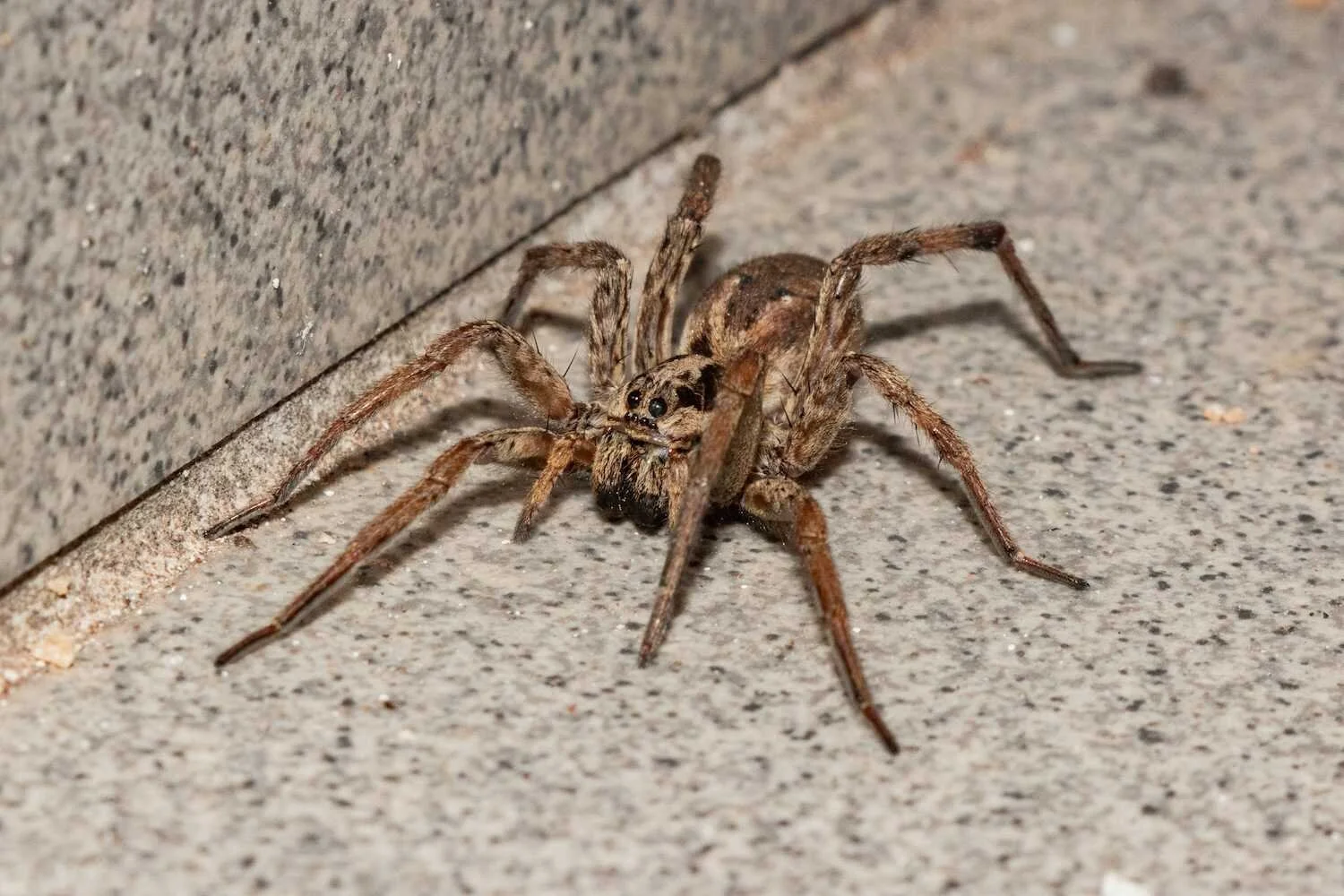
You flick on the kitchen light at 2 a.m., and something brown, hairy, and fast darts across the tile. If you live anywhere between San Diego and Sacramento, there's a decent chance you just met a wolf spider in California — one of over 120 species that call this state home.
Before you grab a shoe, here's what you should know: that spider is completely harmless to you, and it's been quietly eating the bugs you actually don't want around.
What Exactly Is a Wolf Spider?
Wolf spiders belong to the family Lycosidae — the name comes from the Greek word lykos, meaning wolf. But the comparison isn't about temperament. It's about how they hunt. Unlike the orb weavers hanging in your garden or the black widows hiding in your garage, wolf spiders don't build webs to trap prey. They chase it down on foot, sometimes over surprisingly long distances, or sit at the mouth of a shallow burrow and ambush whatever walks by.
That's a big deal in the spider world. Most spiders are sit-and-wait predators that rely on silk. Wolf spiders rely on speed, strength, and — this is the weird part — really good eyesight.
They have eight eyes arranged in three rows. The bottom row has four small eyes. The middle row has two massive forward-facing eyes that give them excellent night vision. And on top sit two more medium-sized eyes for peripheral awareness. If you've ever pointed a flashlight across your yard at night and seen tiny green diamonds glowing back at you from the grass, those were wolf spider eyes. They have a reflective tissue layer called the tapetum lucidum — the same thing that makes cat eyes glow in headlights.
If you're not sure whether the spider on your floor is a wolf spider or something else entirely, a spider identifier can help you narrow it down fast. The eye arrangement alone is usually enough to separate wolf spiders from look-alikes like grass spiders or nursery web spiders, but body shape, hair patterns, and behavior all matter too.
Species You'll Actually Run Into in California
California's geography — coast, desert, valley, mountains — means different wolf spider species show up in different places. Here are the ones most Californians encounter:
Schizocosa mccooki (McCook's Split Wolf Spider)
This is probably the most common wolf spider you'll find around homes and farms in the Sacramento Valley. Adults measure about 1.5 inches including legs, with hairy brown bodies and a faint heart-shaped mark on the abdomen. Males do an elaborate leg-drumming courtship dance — researchers have actually found that they create more complex rhythms for larger females.
Pardosa species (Thin-Legged Wolf Spiders)
Smaller and more delicate-looking than Schizocosa, Pardosa species are everywhere along California's coast and near water. They have noticeably long, thin legs relative to their body and are often found near streams, ponds, and irrigated fields. If you're hiking along a creek in Marin County or the Central Coast and tiny brown spiders scatter when you step on a rock, those are almost certainly Pardosa.
Hogna carolinensis (Carolina Wolf Spider)
The big one. Females can have a body length over an inch, and with legs extended, they easily span two inches or more. Their coloring is a nearly uniform dark brown. These prefer dry, open ground — sandy fields, grasslands, rocky hillsides. In Southern California, they're the species most likely to get mistaken for a small tarantula.
Arctosa littoralis (Shoreline Wolf Spider)
As the name suggests, this one lives on beaches and tidal flats. Its coloring blends perfectly with sand — pale gray and tan with subtle mottling. You'll find them along the California coastline, and they occasionally wander indoors during spring.
Allocosa subparva
A species with no common name, found in forested areas near water. Unusual among wolf spiders for looking almost hairless. They have black bodies with amber-striped legs and a tan splotch on the abdomen. Less than an inch across as adults.
Funnel-Web Wolf Spider (Sosippus californicus)
The oddball of the group. Unlike every other California wolf spider, this one actually does build a web — a funnel-shaped structure on the ground. Females stay close to their webs. Males don't last much beyond mating season.
How Big Do Wolf Spiders Get in California?
This is usually the first thing people want to know — because the spider they just saw looked enormous.
Wolf spider size varies a lot depending on species and sex. The smallest adults in California, like many Pardosa species, have a body length around half an inch. That's about the size of a dime. The largest — Hogna carolinensis females — can have a body over an inch long. Stretch the legs out and you're looking at two inches or more from tip to tip, roughly the diameter of a golf ball.
Most of the wolf spiders you'll encounter in a typical California backyard or garage fall somewhere in the middle: body about three-quarters of an inch, total leg span around an inch and a half. Schizocosa mccooki, the one that shows up most often around Sacramento Valley homes, sits right in this range.
They also look bigger than they are. The dense coat of hair covering their body and legs adds visual bulk, and because they flatten out when resting on a surface, they appear wider than their actual body mass. Add in the speed — wolf spiders can cross a room in seconds — and your brain tends to overestimate the size by a solid margin.
Females are consistently larger than males across every species. That's true for most spiders, but it's especially obvious with wolf spiders because male adults often look like a completely different animal — smaller, thinner, longer-legged, and more active. If you're seeing a smaller, leggy wolf spider darting around erratically in late summer, that's a male looking for a mate.
How to Tell Them Apart from Dangerous Spiders
This is where most of the panic comes from. You see something big, brown, and fast, and your brain jumps to "brown recluse" or "something venomous." In California, though, brown recluses essentially don't exist outside of a few desert counties in the far southeast. The spider in your garage is almost certainly not one.
Here's a quick way to separate wolf spiders from the species that actually matter medically:
Wolf spiders have eight eyes in three rows, with two large eyes front and center. Brown recluses have six eyes in three pairs, and a violin-shaped marking on their cephalothorax. Black widows are shiny, jet-black, and hang upside down in messy cobwebs — nothing like a wolf spider's ground-level hunting style.
Wolf spiders also move differently. They run. Fast. Black widows barely move at all unless disturbed, and brown recluses are secretive and slow. If the spider you saw sprinted across the floor like it had somewhere to be, it's a wolf spider.
Not sure what you found in your house or yard? Snap a photo and run it through Insectio, a free insect identifier app. It works on spiders too — just upload the picture, and it'll match the species based on visual features. Handy for settling the "is that dangerous?" question without having to get closer than you'd like.
Are Wolf Spiders Poisonous?
Short answer: no. But this question comes up constantly, so it's worth unpacking.
"Poisonous" means something is harmful if you eat it or touch it — think poison dart frogs or certain mushrooms. Wolf spiders are not poisonous by any definition. You could theoretically handle one bare-handed without absorbing any toxin through your skin (though the spider would prefer you didn't).
What wolf spiders are is venomous. That means they inject venom through a bite. All wolf spiders have venom glands and fangs — they need them to liquefy the insides of the insects they eat. But the venom is calibrated for prey that weighs a fraction of a gram. On a human, it produces about as much reaction as a bee sting: brief pain, mild swelling, some redness. That's the extent of it.
So when someone asks "are wolf spiders poisonous?" what they really mean is "should I be worried?" And the answer is no. California's wolf spiders are not medically significant. They're not in the same category as black widows or brown recluses, both of which have venom that can cause real tissue damage or systemic reactions.
Are Wolf Spiders Dangerous?
Not to humans, no. This is the other question that drives a lot of unnecessary panic.
Wolf spiders look intimidating — big, hairy, fast — and that appearance triggers a fear response that has nothing to do with actual risk. In practical terms, a wolf spider in your house is about as dangerous as a house gecko. Less, actually, since the gecko might startle you by dropping from a wall.
Wolf spiders don't chase people. They don't jump at you. They don't exhibit territorial behavior toward humans. Every documented wolf spider bite has occurred because the spider was physically cornered — trapped inside clothing, pressed against skin under bedsheets, squeezed inside a shoe or gardening glove. Remove the accidental contact, and the bite risk drops to essentially zero.
For the average healthy adult, even a bite requires nothing more than basic wound care. Children and people with compromised immune systems should keep an eye on any spider bite for signs of allergic reaction, but that's a precaution that applies to any insect or arachnid bite, not something specific to wolf spiders.
Bottom line: if you rank California's household critters by actual danger, wolf spiders fall well below wasps, bees, fire ants, and the black widow spiders that genuinely do live here.
Wolf Spider Bites: What Actually Happens
Let's get this out of the way: wolf spiders can bite. They have fangs. They are venomous — technically. But their venom is designed to subdue crickets and beetles, not humans.
A wolf spider bite is roughly equivalent to a bee sting. You'll feel a pinch, maybe see some redness and mild swelling around the site, and it'll be uncomfortable for a few minutes to a few hours. That's it. No necrotic wounds, no lasting damage, no trip to the ER.
The rare exceptions involve people with specific allergies to spider venom, very young children, or elderly individuals with compromised immune systems. In those cases, symptoms like nausea, headache, or muscle cramping around the bite warrant a doctor visit. But for the vast majority of people, soap, water, and an ice pack are all you need.
Wolf spiders are also not aggressive. They bite almost exclusively when physically trapped — stepped on inside a shoe, rolled onto in bed, pressed against skin inside a glove. Left alone, they'll run from you every time.
The Mother Spider That Carries Her Babies
This is the thing about wolf spiders that genuinely freaks people out, and honestly, it's also the most impressive.
After mating, a female wolf spider produces a silk egg sac containing anywhere from 50 to 200 eggs. She attaches it to her spinnerets — the silk-producing organs at the tip of her abdomen — and carries it with her everywhere. She holds her body slightly elevated to keep the sac off the ground, and she continues to hunt, eat, and move normally while hauling it around.
When the eggs hatch, the spiderlings climb out of the sac and up onto their mother's back. Dozens of tiny spiders, sometimes over a hundred, clinging to her abdomen and riding along as she goes about her life. She carries them like this for one to two weeks until they're large enough to disperse on their own.
This is why you should never squish a wolf spider you find indoors. If it's a mother carrying spiderlings, the impact can scatter hundreds of baby spiders in every direction. Catch-and-release with a cup and a piece of paper is always the better move.
Where They Live and When You'll See Them
Wolf spiders are ground creatures. They don't climb walls well, they don't build aerial webs, and they don't hang from ceilings. Outdoors, you'll find them under rocks, in leaf litter, beneath logs, in grass, and along the edges of foundations. Some dig shallow burrows.
In California, they're active year-round in warmer coastal and southern regions, but their visibility peaks in late summer and fall. That's mating season — males start wandering widely in search of females, which is when they're most likely to end up in your house. They enter through gaps under doors, cracks in foundations, or open garage doors, usually following insect prey.
They're nocturnal hunters, which is why most encounters happen at night. During the day, they tuck into dark, sheltered spots — under furniture, behind boxes in the garage, inside shoes left by the back door.
Keeping Them Out of Your House
Wolf spiders inside the house are a symptom, not a problem. If they're coming in, it's because they're following food — and their food is other bugs. Reduce the insects in and around your home, and wolf spider visits drop off.
Seal gaps around doors and windows. Fix torn screens. Move woodpiles and debris away from the foundation. Keep outdoor lights off at night or switch to yellow bulbs, since standard white lights attract the insects that attract the spiders. Inside, vacuum regularly and reduce clutter in basements, garages, and storage areas.
Shake out shoes, gloves, and clothing that's been sitting undisturbed. This is the single best habit for avoiding bites — not because the spider is hunting you, but because it might have settled into a dark, tight space that you're about to stick your hand into.
Why You Might Want Them Around
Wolf spiders eat earwigs, crickets, ants, beetles, cockroaches, and even other spiders. A healthy population of wolf spiders around your yard means fewer of those pests making it through your door. In agricultural areas of the Central Valley, wolf spiders are considered beneficial because they help control crop-damaging insects without any need for pesticides.
They're also an important food source for birds, lizards, frogs, and small mammals. In riparian habitats along California's rivers and streams, wolf spiders are part of the energy chain that connects terrestrial and aquatic food webs.
They're not pests. They're pest control.
The Bottom Line
Wolf spiders in California are common, widespread, and completely harmless to people. They look scarier than they are — big, hairy, fast — but every one of them would rather run from you than bite you. They don't infest homes, they don't build webs in your doorways, and they don't pose any medical risk worth worrying about.
If you find one inside, carry it outside. If you find one in your yard, leave it alone. And if you're curious what species it is, grab a photo and look it up — between their eye patterns, body markings, and habitat preferences, wolf spiders are actually some of the easier spiders to identify once you know what to look for.