
What Travelers Should Know Before Planning a Private Expedition to the South Pole
There are bucket-list destinations, and then there is the South Pole.
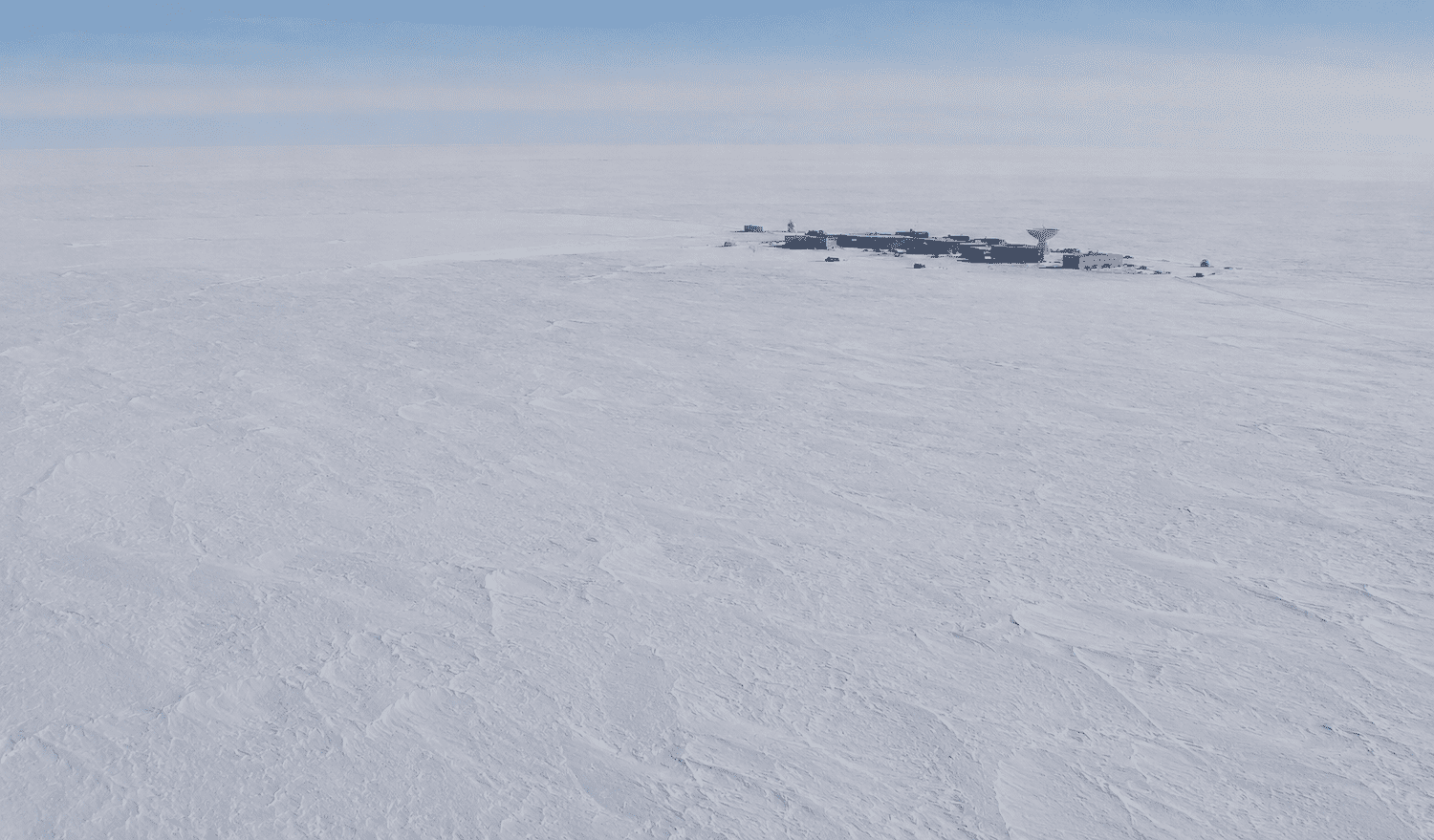
Standing at 90 degrees South, on a plateau that sits nearly 9,300 feet above sea level, in temperatures that regularly fall below -30 degrees Celsius even in high summer, travelers who reach this point are not simply ticking a box.
They are completing one of the most demanding and logistically intricate journeys available to any private individual on earth.
Interest in private polar expeditions has grown considerably in recent years.
For UHNW travelers and adventure-focused clients who have already visited the conventional bucket-list destinations, the Antarctic interior represents something different: a place where access itself is the achievement, and where the quality of your operator is not a preference but a matter of safety.
Whether your curiosity was sparked by the stories of Amundsen, Scott, and Shackleton, or simply by a desire to go somewhere genuinely few have been, what follows is what you need to understand before any serious planning begins.
The South Pole is not the same as Antarctica
Most travelers associate Antarctica with its Peninsula: iceberg-studded channels, wildlife colonies, and spectacular coastal scenery accessible by expedition ship.
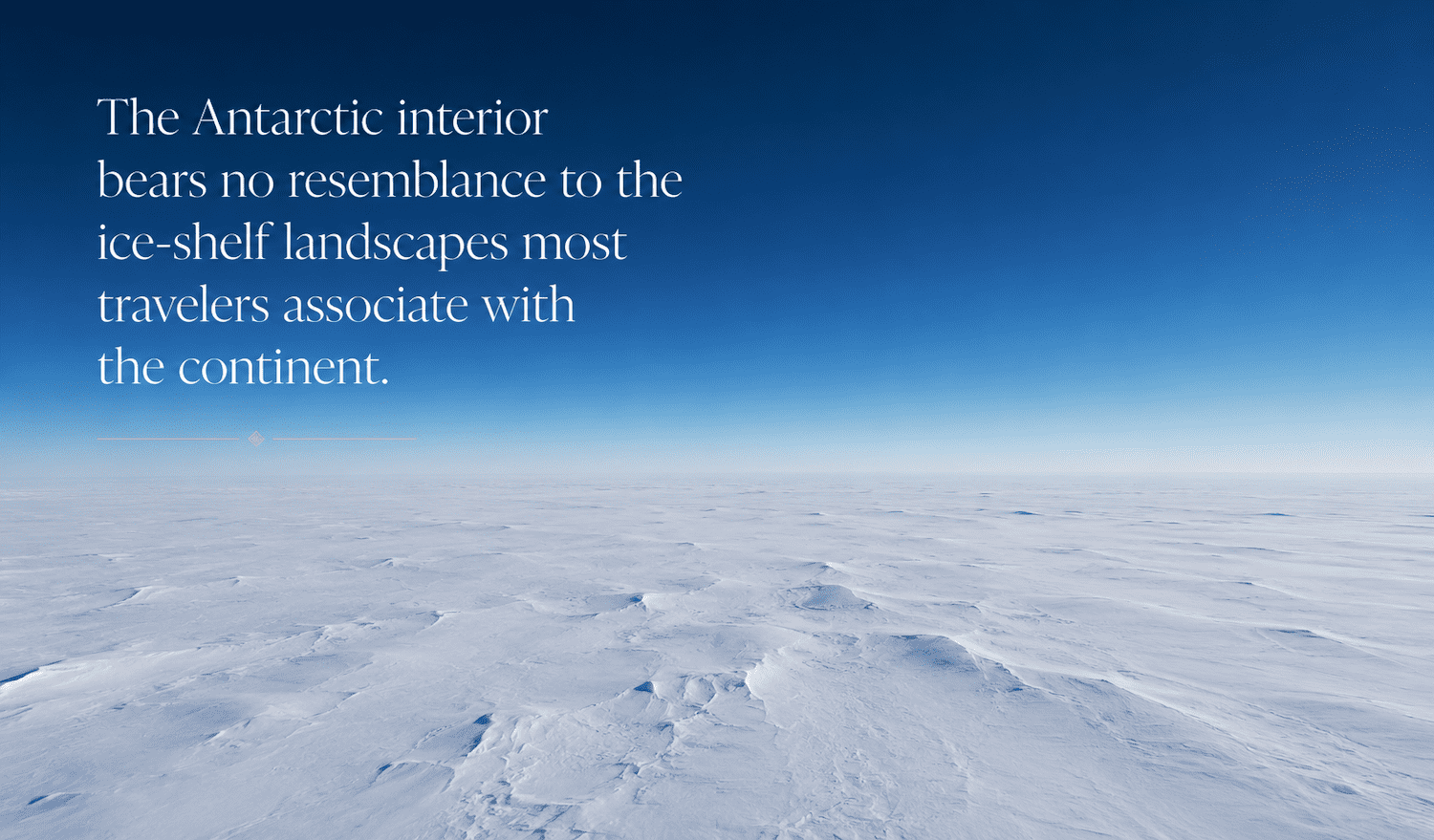
The South Pole is an entirely different proposition. It sits deep in the continental interior, on a polar ice sheet averaging over 1.5 miles thick, at an altitude that causes genuine altitude-related symptoms for many visitors.
There are no penguins, no open water, and no scenery in the conventional sense. What there is, instead, is scale, silence, and a form of raw geography that is genuinely difficult to process until you are standing in it.
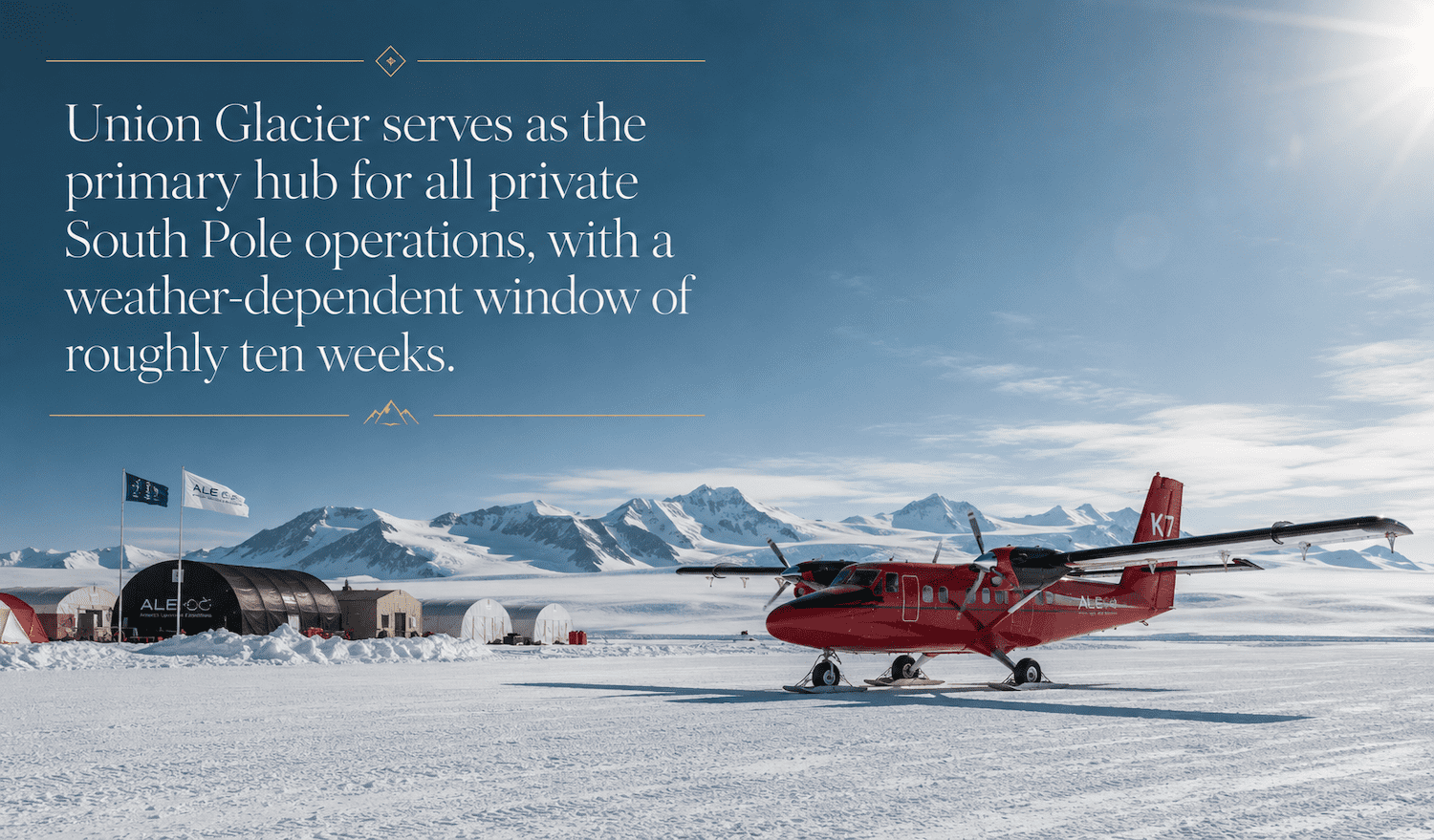
The access route typically involves a charter flight from Punta Arenas in southern Chile to Union Glacier Camp, which serves as the principal staging point for deep interior operations.
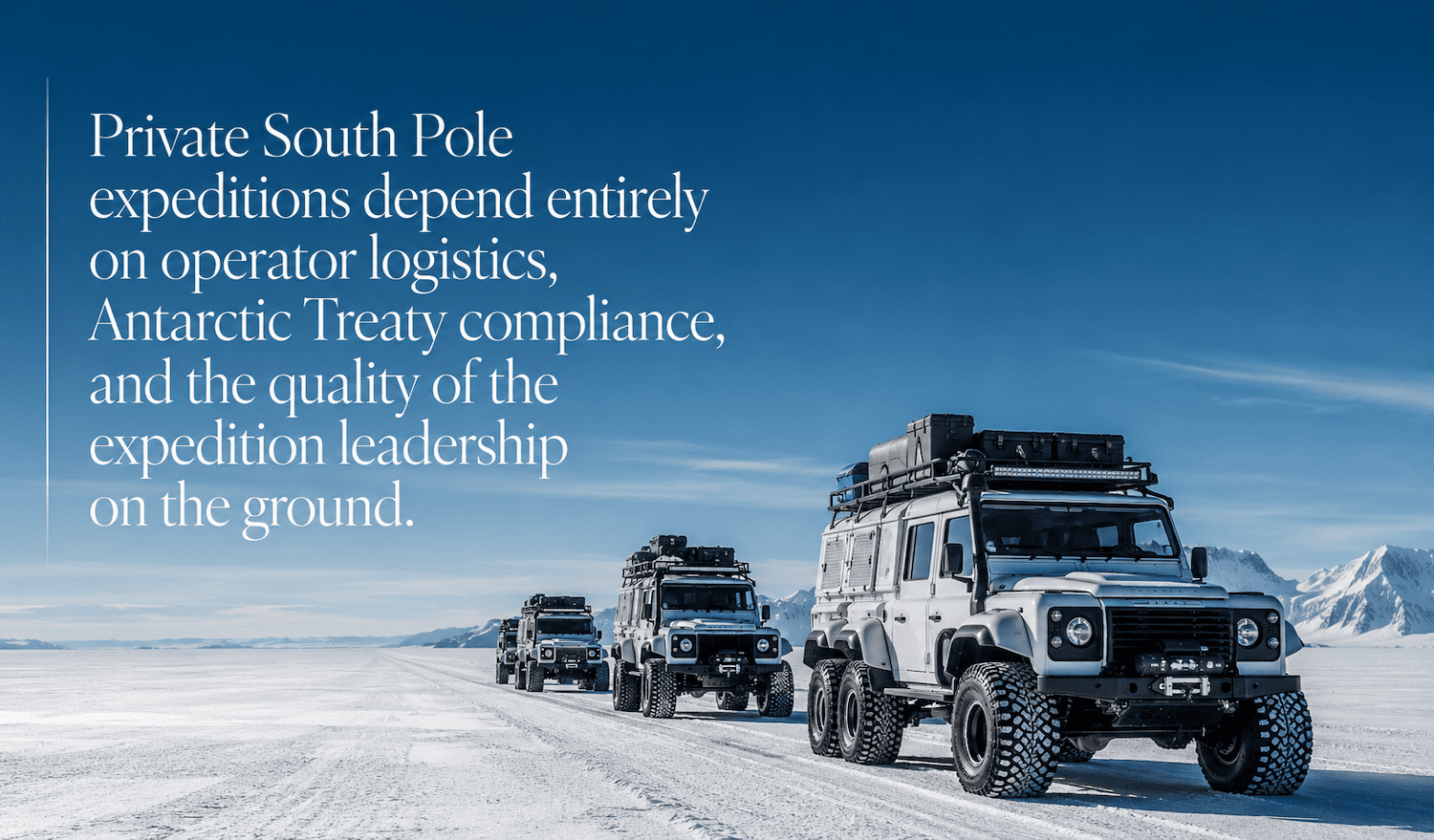
From the Union Glacier, the journey to the South Pole is completed either by ski traverse, by purpose-built overland vehicle, or by a combination of both, depending on the itinerary you have designed with your operator.
Timing is extremely narrow
The operational season for private South Pole expeditions runs from approximately late October through mid-January.
Outside of this window, the weather and darkness make the journey effectively impossible for private operations.
Even within the season, weather at the South Pole itself is unpredictable. Flights to Union Glacier and onward traverse operations are entirely condition-dependent, and any honest operator will tell you that building significant flexibility into your timeline is not optional. It is part of the plan.
This has a direct bearing on how you structure the broader itinerary.
Travelers often combine a South Pole expedition with time in Patagonia, either in Punta Arenas or the broader Chilean and Argentine lake district, to allow for weather delays without the entire trip feeling contingent on a narrow window.
The best operators design the logistics around this reality from the outset, rather than treating weather disruption as an unfortunate variable.
Choosing the right operator changes everything
This is not an area where the distinction between operators is marginal.
The South Pole has no infrastructure beyond the Amundsen-Scott South Pole Station, which is operated by the US Antarctic Program and is not available to private parties for accommodation or emergency logistics.
Private expeditions are entirely self-supporting, which means that your operator's capability is the only safety net available.
The differentiating factors are field experience, permit expertise, and operational depth. All expeditions to the Antarctic interior require coordination with the Antartic Treaty System framework, and experienced operators have established relationships with logistics providers, aviation partners, and the established Antarctic camp infrastructure.
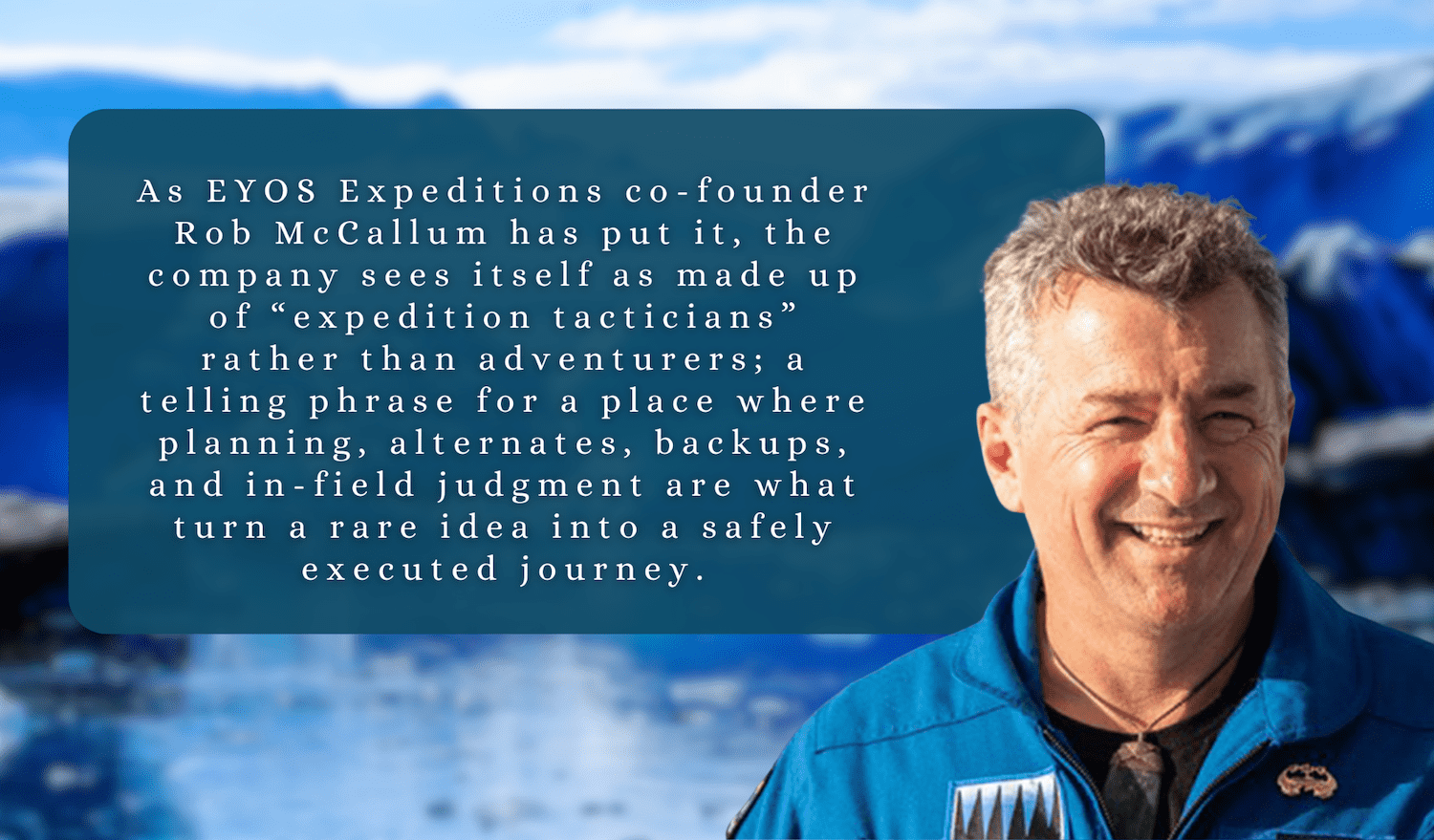
EYOS South Pole luxury expeditions are built around this very principle: field-tested leadership, flexible itinerary design shaped by conditions, and the operational background to move intelligently within the constraints that make this destination as demanding as it is rare.
That distinction matters at the South Pole, where luxury is not measured by excess, but by competence.
For UHNW clients and private travelers approaching this destination for the first time, the right question is not which operator offers the most impressive brochure.
It is which operator has actually done this, repeatedly, and can demonstrate the judgment and logistical infrastructure to handle the range of scenarios the Antarctic interior can present.
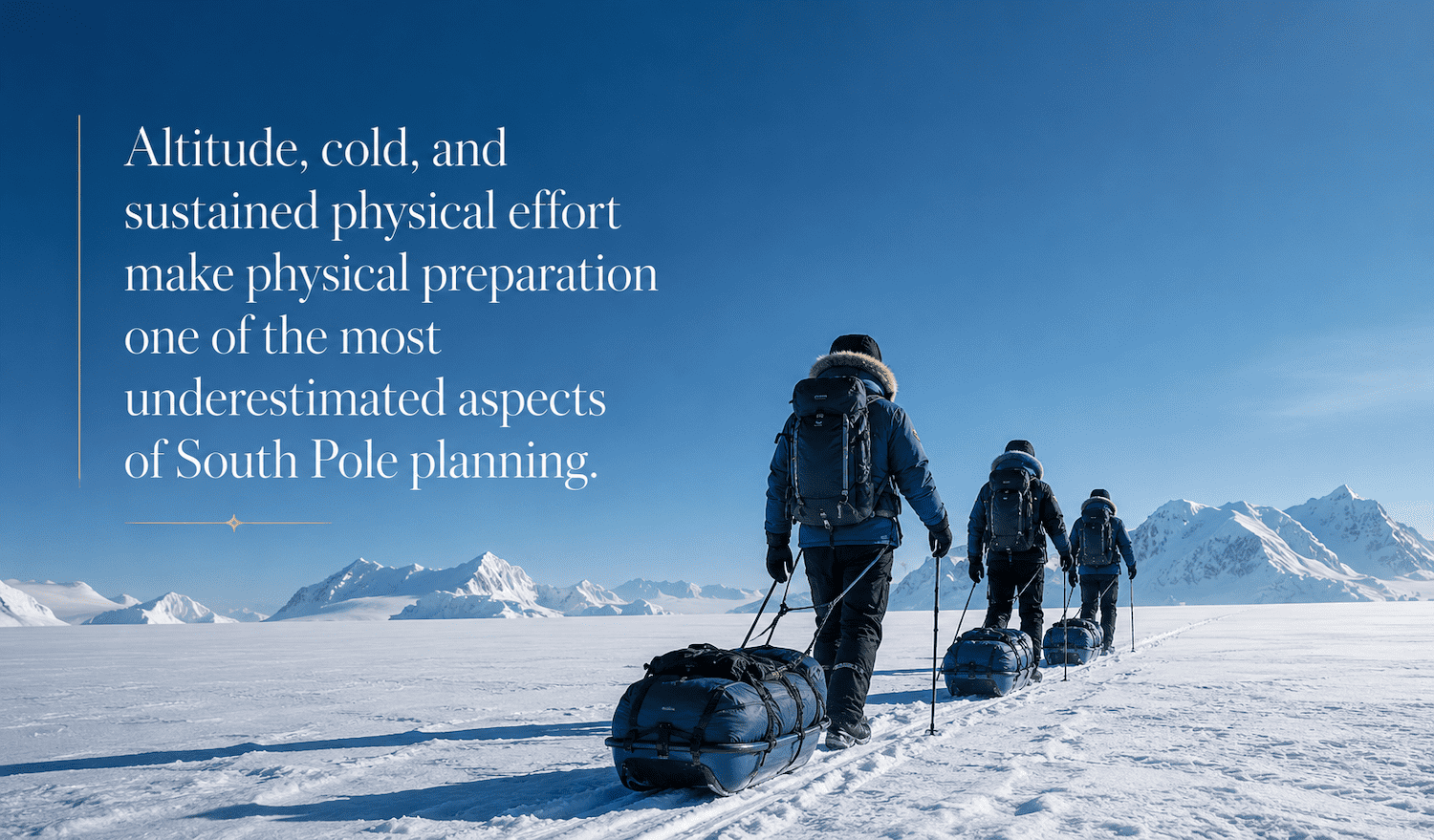
Physical preparation is non-negotiable
The South Pole sits at an elevation equivalent to roughly 11,000 feet of physiological altitude due to the polar atmosphere, which compresses air pressure at high latitudes.
Many travelers experience genuine altitude sickness symptoms in the first 24 to 48 hours at the Pole, even those who are otherwise fit. A few preparation points are especially important:
Build aerobic endurance before the trip.
Long walks, hill climbs, weighted pack training, cycling, rowing, or steady-state cardio can help prepare the body for sustained movement rather than short bursts of effort.
Train with layers and weight where possible.
Moving in polar clothing is different from exercising in lightweight gear. Even simple movement becomes more demanding when wearing insulated boots, gloves, heavy outerwear, and carrying essentials.Prepare for altitude, not just cold.
The South Pole’s physiological altitude can surprise travelers who focus only on temperature. Headaches, fatigue, nausea, poor sleep, and shortness of breath can all appear early, so acclimatization planning and medical guidance should be taken seriously.Do not underestimate recovery.
Extreme environments make the body burn energy quickly. Hydration, nutrition, sleep, and pacing are part of preparation, not afterthoughts.Let the operator guide the gear list.
Gear selection is another area where most travelers benefit from expert guidance rather than independent research. Layering systems for polar conditions are highly specific, and equipment that performs adequately in sub-zero temperatures during a short urban excursion may fail in sustained polar use.
The right expedition operator will usually provide, test, or specify every critical item, from base layers and insulation to outer shells, boots, gloves, face protection, and emergency equipment.
That level of guidance is important because, in Antarctica, comfort and safety are often separated by small technical details especially for the modern explorers who would need these helpful tips.
A poorly chosen glove, inadequate boot system, or wrong layering approach can quickly become more than an inconvenience.
What the experience actually involves
For most travelers, a South Pole expedition begins long before reaching the Pole itself. The journey usually starts in Punta Arenas, Chile, which acts as the main gateway for private Antarctic expeditions. From there, travelers fly to Union Glacier, a remote Antarctic camp that serves as the staging point for the onward journey.
Union Glacier is where the trip starts to feel real. Travelers typically spend time acclimatizing, checking gear, meeting guides, and waiting for the right weather window. In Antarctica, weather decides everything. Flights, overland movement, and even daily activities depend on visibility, wind, temperature, and runway conditions.
The setting is already unlike anywhere else. Union Glacier has a blue ice runway, wide open snowfields, mountain ranges in the distance, and during the Antarctic summer, a sun that does not set. It is not a luxury resort environment in the usual sense. It is remote, functional, and extraordinary because of where it is.
From Union Glacier, travelers continue toward the South Pole either by flight, overland vehicle, ski-supported route, or a combination depending on the itinerary. For those flying in, the arrival at the Pole is often the emotional high point. For those doing an overland traverse, the journey across hundreds of miles of empty Antarctic plateau becomes just as important as the destination.
At the South Pole itself, travelers usually visit the Geographic South Pole marker, which marks 90 degrees South. Nearby is the Ceremonial South Pole, surrounded by the flags of the Antarctic Treaty nations. The Amundsen-Scott South Pole Station, a working U.S. research station, can also be seen from the area, though visitor access is limited and highly controlled.
The experience is not only about standing at a famous point on the map. It is about understanding the scale of the place. There are no towns, roads, shops, hotels, or casual detours. Everything has to be planned, carried, flown in, or supported by the expedition team.
Some itineraries may also include activities around Union Glacier, such as short ski experiences, guided walks, hiking in the Heritage Range, or time spent exploring the polar desert. These are not added simply for entertainment. They help travelers experience Antarctica beyond the photo moment: the silence, the distance, the wind, the light, and the feeling of being in a landscape where very few people have ever stood.
A well-designed South Pole expedition should therefore feel carefully paced. It should give travelers enough preparation to feel safe, enough flexibility to respect the conditions, and enough time to appreciate the destination rather than rushing through it. From the first planning call to the final return to Punta Arenas, the experience should match the seriousness, rarity, and scale of reaching one of the most remote places on Earth.
Key things travelers should understand before going
The journey starts before Antarctica
Union Glacier is the main staging point
Weather controls the schedule
The Pole is not a tourist site in the usual sense
The Geographic South Pole is the main milestone
The research station is visible but not freely accessible
The journey may matter as much as the arrival
Activities depend on the itinerary and conditions
Comfort looks different here
The best expeditions feel calm, not rushed
A note on permits, the Antarctic Treaty, and conservation
Antarctica is governed by the Antarctic Treaty System, which requires that all private expeditions are submitted for review by the relevant national authority before travel.
Experienced operators manage this permitting process as standard, but travelers should be aware that it adds a formal planning lead time to any expedition, and that certain activities may require additional approvals.
The conservation principles that apply to coastal Antarctic tourism are even more strictly observed in the interior, where the absence of any permanent non-scientific infrastructure means that all waste, human waste included, must be managed and removed.
The best operators treat environmental stewardship not as a regulatory requirement but as a core part of how they operate, and this is worth assessing directly when selecting a partner for an expedition of this consequence.